
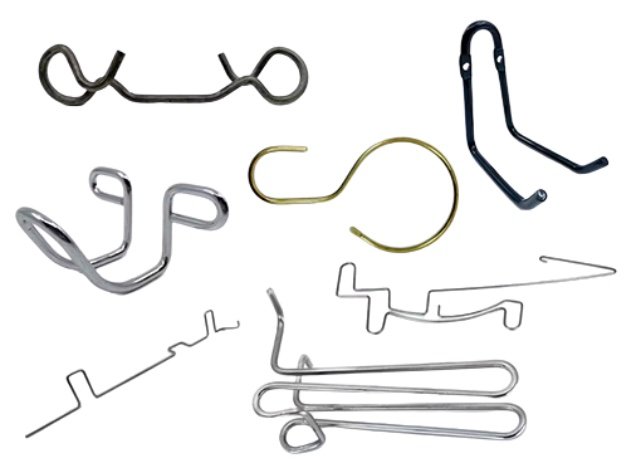
Wire Forms
Custom wire forms,
bent in Thailand.
Wire forms and bent wire components — simple bends or multi-plane geometries — formed from 0.08–8.0 mm wire, with a planned expansion to 12.0 mm.

From a single bend to a multi-plane form
Wire forming is a drawing-driven process: wire diameter, bend radius, leg length and the tolerance that matters in the assembly decide how the part is tooled and inspected.
We form in 2D and 3D, check the first article against the drawing, and use a 2.5D vision system for critical dimensions. If a bend cannot be held consistently at the specified tolerance, we raise it before production.
- 2D and 3D bends, loops, hooks and U-forms
- Wire 0.08–8.0 mm in current production
- Carbon spring steel and stainless steel
- First-article inspection and 2.5D dimensional checks
Where wire forms replace assembly steps
A formed wire part can replace several loose components, locate itself in an assembly or provide a custom attachment point. The drawing defines the geometry and the tolerance that matters.
Wire form specifications
Current production is shown below. Form feasibility and critical tolerances are reviewed against the drawing at RFQ.
| Parameter | Capability |
|---|---|
| Wire diameter | 0.08–8.0 mm in current production. Planned expansion to 12.0 mm as new equipment is installed. |
| Materials | 65Mn, 72A, 82B, 60Si2Mn; stainless steel 301, 302, 304 and 316. |
| Form types | 2D and 3D bends, loops, hooks, U-forms and custom wire geometries to drawing. |
| Heat treatment | Stress relief where the drawing or forming process requires it. |
| Surface finish | Anti-rust oil, electrophoresis (E-coat), zinc plating, nickel plating, spray coating. |
| Wire tolerance | JIS wire tolerance by grade (JIS G 3521, JIS G 3522 or JIS G 4309). ASTM wire specification and SMI commercial tolerances available for US programs. |
| Dimensional inspection | 2.5D vision measurement and first-article inspection against the drawing. |
| Quality system | ISO 9001:2015 and ISO 14001:2015. |
| Samples | Prototype and pre-production samples against drawing. |
Wire diameter is inspected to the JIS tolerance of the ordered wire grade. For US programs, we can quote and inspect to the relevant ASTM wire specification and SMI commercial tolerances.
Materials and finishes
The wire grade and finish should follow the load, forming severity and corrosion exposure of the application — not a default.
65Mn · 72A · 82B · 60Si2Mn
Used where the formed part needs spring temper, strength or a defined load-deflection behaviour.
301 · 302 · 304 · 316
Selected where corrosion resistance or a clean surface matters more than the higher strength of carbon wire.
Oil · E-coat · zinc · nickel · spray
Anti-rust oil, electrophoresis, zinc plating, nickel plating and spray coating are available for formed parts.
Measured where the drawing says it matters
Formed parts are checked against the drawing, with critical dimensions measured on a 2.5D vision system. Incoming wire is tested before it enters production.
- Incoming wire tensile strength and metallographic structure
- 2.5D vision measurement of formed dimensions
- First-article inspection against the drawing
- Salt spray testing for plated and coated parts
- Load testing where the form acts as a spring
- Inspection records agreed at RFQ


What to send with your drawing
A complete drawing shortens the quote and removes assumptions.
- 2D or 3D drawing (PDF, DXF or STEP)
- Wire diameter and material grade
- Bend radii and leg lengths
- Critical dimensions and tolerances
- Surface finish and operating environment
- Annual quantity and delivery schedule
PDF, DXF, STEP or a clear photo
Email your drawing to info@aofengspringthailand.com. We confirm the form feasibility, wire range, finish and inspection plan before quoting.
Wire form questions
What wire sizes can you form?
0.08–8.0 mm in current production, with a planned expansion to 12.0 mm. We confirm the range for the specific form at RFQ.
How do you inspect formed dimensions?
Critical dimensions are measured on a 2.5D vision system, and the first article is checked against the drawing before production.
Can you make prototypes or small batches?
Yes. We produce prototype and pre-production runs before volume production.
Which finishes are available?
Anti-rust oil, electrophoresis (E-coat), zinc plating, nickel plating and spray coating.
Send a drawing, get a quote
Send the 2D or 3D drawing and tell us which dimensions are critical. We will confirm feasibility and the inspection plan before quoting.
AOFENG SPRING (THAILAND) · Rayong, Thailand