
Valve application
Springs for safety, ball
and aerosol valves.
The set pressure has to hold — and it still has to hold after a hundred thousand cycles. Three numbers decide whether it will: force tolerance, permanent set and stress relaxation. Those are the numbers we quote against.
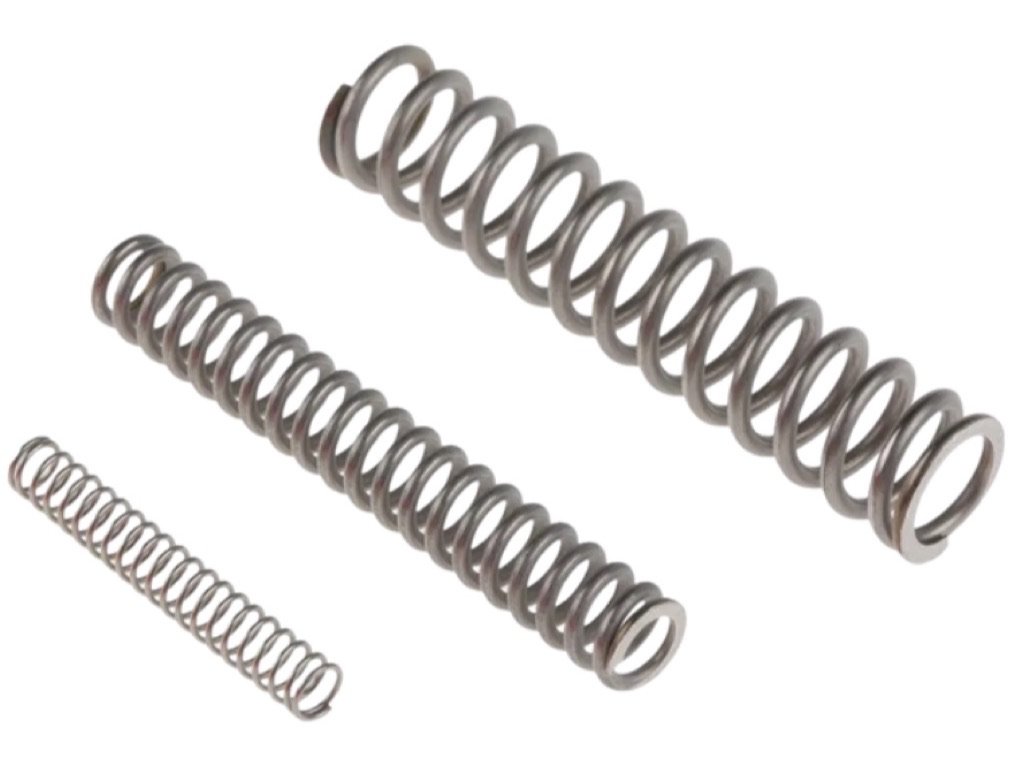
In valves, the spring is the calibration
Valve engineers do not ask whether the spring is strong enough. They ask whether the force is still accurate after several years and several hundred thousand cycles. In a safety valve, that one spring is the set pressure.
So we work to three measures rather than one: force tolerance, permanent set and stress relaxation. Hold those three and the set pressure holds with them.
- Who we serve — industrial valves, HVAC valves, aerosol valves, fluid control components and hydraulic pumps
- Parts we run — relief valve springs, ball and butterfly disc spring stacks, check valve return springs, aerosol valve springs, hydraulic pump return springs
- What to send — set pressure, working stroke, medium and temperature, required cycle count
Force tolerance, permanent set, relaxation
- Force tolerance — the load window at installed height, stated on the drawing
- Permanent set — how much length is lost after the first compression to solid or to proof load
- Stress relaxation — how much force is lost while held compressed at temperature over time
All three are tested and reported. A supplier that only quotes load at installed height has answered one third of the question.
Four valve types, plus hydraulic pumps
Safety and relief valves
The set pressure rests entirely on the spring. Force tolerance, permanent set and relaxation have to be written into the drawing — this is the one set of numbers the industry actually cares about, and the easiest for a supplier to leave vague.
Ball and butterfly valves
Disc spring stacks provide the sealing preload. Stack count, stiffness matching and compression travel decide the seal life; a single-disc specification on its own means nothing.
Check valves
Mostly small-wire return springs. The difficulty is medium compatibility and staying free from sticking over a long service life, not the load itself.
Aerosol valves
Tiny parts in large numbers. Seal face fit and batch consistency are what matter; stainless is the usual material choice.
Hydraulic pumps
Plunger pump return and centre-return springs; floating side-plate pressure springs in gear pumps. The problem is stress relaxation under sustained compression — lose a little force and the displacement and pressure setting drift with it.
Stacks, not single parts
Where a valve uses a disc spring stack, we supply the stack as a matched set: same lot, measured and paired, so the preload does not depend on which disc came out of the box.
Material certificates follow the batch
A valve SQE normally asks for two things: proof of material and a process record. Both are supplied per project agreement.
| Item | What is provided |
|---|---|
| Standard materials | SUS304 and SUS316L as the default, confirmed against medium and temperature |
| Material certificate | Issued with the batch |
| Process records | Heat treatment and inspection records available on request |
| Inspection | Load, free length, permanent set, salt spray and cycling, as agreed |
| Traceability | Lot number linked to wire heat number, machine and inspection record |
Records are issued in the format agreed at RFQ. Where your own incoming-inspection template applies, we fill that document instead of ours.
On compliance, we only claim what we can answer for
We supply the spring, not the valve. So you will not read “API compliant”, “PED compliant” or “CE compliant” anywhere on this page. Certification of the finished valve belongs to the valve maker — a component supplier cannot make that promise on a customer’s behalf.
What we can do is make the part correct to the duty and the drawing you give us, supply the full material and process records, and let your valve certification proceed without a missing document.
- We can commit to — material certificates with every batch, process records on request, advance notice of any change
- We do not commit to — certification of the assembled valve, or a final conclusion on medium suitability
- Suggested route — send the duty parameters first; we confirm material and inspection items together, then the drawing is fixed
The plant is written on the quotation
A valve project traces back to the material source. Volume runs in Rayong, material certificates follow the batch, and the records line up at audit. The group plant only covers backup volume and special projects, and when it does, the origin is stated on the quotation rather than discovered later.
Volume in Rayong, group as backup
- AOFENG SPRING (THAILAND), Rayong — forming, heat treatment and inspection for standard valve springs, return springs, disc spring stacks and hydraulic pump return springs. Large stable volume runs here; equipment is added as the order grows.
- Guangdong Aojin Precision Technology, Zhaoqing — ultra-fine wire and special materials handled by the group as capacity backup, with 100+ test and inspection machines.
- Quotation — by part number. Volume is scheduled in Rayong first, and material certificates are issued for the actual origin.
Families used in valves
Valve spring questions
Can you supply springs to a set-pressure specification?
Yes, stated as a load at installed height with a tolerance band. We test to that window and report the result. The set pressure of the assembled valve is confirmed by the valve maker, not by us.
Do you supply disc spring stacks or single discs?
Both. A stack is supplied as a matched set from one lot, measured and paired so the preload does not vary from disc to disc. Stack count and stiffness matching are confirmed against your drawing.
How do you control stress relaxation?
Through material choice, stress relief after forming and, where the duty demands it, a proof or preset cycle before delivery. Relaxation is measured to the temperature and duration agreed at RFQ.
Do you provide material certificates?
Yes, with every batch. Heat treatment and inspection records are available on request, in the format agreed at RFQ.
Are your springs API, PED or CE compliant?
We do not make that claim. Those certifications apply to the finished valve. What we provide is the spring to your drawing plus the material and process records your certification needs.
Which stainless grade for a corrosive medium?
SUS316L is the usual starting point where the medium is aggressive. The final choice follows the medium, the temperature and your own standard, confirmed before the drawing is fixed.
Send the duty parameters first
Set pressure, stroke, medium, temperature and cycle requirement are enough to start. We will confirm the material and inspection items before the drawing is fixed.
AOFENG SPRING (THAILAND) · Rayong, Thailand