
Application Guide
Appliance springs:
the second batch is the real test.
A refrigerator door hinge, a washing-machine drum and a compressor valve plate all put different demands on a coil. What they share is that nobody notices the spring until the line stops — and the line usually stops on batch two, not batch one.
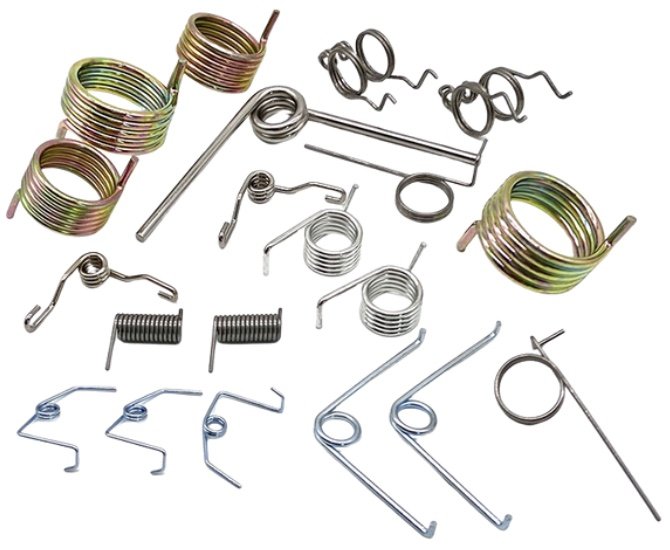
Appliance springs sell for cents. That is exactly why they get under-managed. A purchasing team looks at the part, sees something small and cheap, and puts the effort into the compressor, the motor or the electronics instead. Then a spring locks up a hinge, a door sags on a showroom unit, or a drum starts walking across the floor — and suddenly a part that costs nine cents is costing a shift.
This article is about the five positions where appliance springs do the most damage when they drift, and what actually has to be specified so that batch two behaves like batch one.
Why the first batch is easy and the second batch is not
Almost every supplier gets the first batch right. The tooling is new, the operator is paying attention, the QA engineer walks every dimension because the customer is watching, and often the first article is 100% inspected before it ships.
The second batch is run by a different operator, on a day when the wire reel is from a different mill lot, at the point in the month where everyone is trying to make the delivery date. That is where a coil count slips by one, where a stress-relief oven runs ten minutes short, where an end gets ground flat on one side only.
None of those events is dramatic. Each one changes the force at working height by a few percent — which for an appliance is often the entire tolerance band.
So the question worth asking a supplier is not “can you make this part?” It is “what stops it from changing?” The answer has to be a process, not a promise.
Five positions, five different requirements
Within one appliance there can be a dozen springs. They are not interchangeable engineering problems. Reducing them to a single “appliance spring” specification is how tolerances get written that do not match what the assembly actually needs.
Our appliance and refrigeration page sorts them into five positions. The requirements below are the ones that decide whether each position works.
1. Refrigerator doors and hinges
The door has to hold at an intermediate angle. It should not swing open on its own, and it should not feel stiff to a customer in a showroom. Door torsion springs and hinge return springs are matched by coil count and preload angle to the cabinet structure — which means the spring is only correct relative to a specific door mass and a specific hinge geometry. Change the door, and the spring has to be re-checked. The most common failure here is not breakage; it is a door that droops by two degrees after a year because the spring relaxed.
2. Washing-machine suspension
Damping extension springs and drum suspension springs live in the worst environment in the appliance: wet, often with detergent residue, and cycling hundreds of times a day at high amplitude. Two constraints collide. The first is corrosion — a pitted surface becomes a fatigue crack initiation site, and the mechanism is described in our guide to spring fatigue failure. The second is long-term relaxation: the spring must still hold its rate after thousands of hours compressed and wet. Material and coating have to be selected together, because a coating that flakes in a wet drum is worse than no coating.
3. Inside the compressor
Valve plate springs, wave springs and small retaining rings sit under high-frequency cycling with almost no visible stroke. The load is small, the cycle count is enormous, and the part is buried inside a sealed system. Requirements are dimensional precision and repeatability rather than load capacity. Wave springs are specified for the same reason they exist elsewhere — they deliver a known force in a very short axial space.
4. Louvers and air-path components
Air-conditioner louver springs are torsion or flat springs that set the detent feel of a louver. The requirement is tactile: the louver should click into position and stay there. Wear at the detent, not fatigue, usually ends the life of this part — which means surface treatment and contact geometry matter more than the stress calculation.
5. Clips, latches and small hardware
Clip strips and latch springs are the highest part-number, lowest-value items in the family. They are also the easiest to source badly, because there is rarely a drawing worth arguing over. Two things save them: a single supplier holding common materials in stock, and a consolidated delivery schedule so that forty small part numbers arrive together rather than in forty shipments.
What “same as the first batch” has to mean in numbers
“Consistency” is not a specification. If a purchase order says only that, there is nothing to reject a shipment against. These are the parameters that need a number on the drawing, because these are the ones that drift:
- Wire diameter. On fine appliance wire, a two-micron difference is a measurable rate change. State the gauge and whether the mill lot has to match across a release.
- Active coil count and total coil count. The most common drift in a long production run, and the one that most directly moves the force at working height.
- Free length and load at installed height. Both, not either. A spring can hold its free length and still be wrong at the installed height if the rate moved.
- End treatment. Ground-flat, closed, closed-and-ground, open — and for grounded ends, the flatness and the proportion of the end that is actually bearing.
- Direction of wind and the position of the first active coil. Irrelevant for some assemblies, critical for others, and never stated when it is critical.
- Stress relief. Temperature and time. A cold-coiled spring that missed its stress relief will pass the first dimensional check and fail in service.
The parameters are not exotic. The point is simply that if the drawing does not carry them, the second batch has no obligation to.
Why lot traceability comes before capacity
When an appliance customer visits a supplier, the conversation usually starts with monthly capacity. It should start with traceability.
If a defect appears in the field, the first question is which batches are affected. Without lot-level records tied to wire mill certificate, coil date, heat-treat batch and inspection results, the only honest answer is “all of them” — and that answer means a recall conversation instead of a containment conversation.
Traceability also protects the supplier. A customer complaint that can be traced to one reel lot is a contained problem. The same complaint with no records becomes an argument about the whole relationship.
Material and finish for a wet, cost-sensitive product
Appliance springs are usually stainless, and usually SUS304. It is the sensible default for parts that see condensation, detergent or food contact. Two refinements are worth the conversation:
- Do the parts need passivation? Machined or ground stainless surfaces carry free iron from tooling. Passivation removes it and restores the oxide layer. On a wet laundry spring it is not cosmetic; it is the difference between a passive surface and a corrosion initiation site.
- Is the coating compatible with the environment? A zinc or organic coating on a part that flexes at high amplitude will crack at the highest-stress coil. A cracked coating on stainless is worse than bare stainless, because it traps moisture against the surface.
Why monthly supply from Rayong matters more than the piece price
The appliance supply chain in Thailand is mature, and most of the assembly plants are within a few hours of the eastern seaboard industrial estates. A supplier that winds in Rayong can hold a monthly replenishment rhythm and keep the freight and the lead time short.
For a part that costs under a baht, freight from outside the region can quietly exceed the piece price. More importantly, a local supplier can react when a forecast moves, which a container shipment cannot. Volume above what the Rayong plant runs is handled through the wider group, but the default for appliance families is local production — the point of the local plant is to shorten the loop, not to route it back out.
Send the part list, not one drawing
Appliance projects are families, not parts. A part list with monthly usage per part number lets a supplier price the family together, plan material around the total wire consumption, and propose a delivery schedule that matches the assembly line rather than the shipping calendar.
What actually helps at the quotation stage:
- The part-number list with drawings or current samples
- Monthly or annual usage per part number
- Target piece price and packaging requirement
- Delivery address and replenishment frequency
- Whether lot certificates are required per shipment
With those five items, a family quote is usually straightforward. Without the usage numbers, every part gets priced as a one-off, and the price reflects the uncertainty rather than the part.
The short version
Appliance springs are cheap parts with expensive failure modes. The risk is not that a supplier cannot make the first batch — almost anyone can. The risk is drift: wire lot, coil count, end treatment, stress relief and coating, changing quietly between shipments.
Specify those five, require lot traceability, and keep the supply loop short. The rest is arithmetic.
Related reading: stainless steel spring passivation · why springs break · what changes between the first piece and the millionth · springs for appliances and refrigeration
Have an appliance part family to quote?
Send the part list with monthly usage. We will price the family together and propose a replenishment schedule from Rayong.