
Application Guide
Pump head springs:
what changes between the first piece and the millionth.
Two or three springs sit inside every pump head. They weigh milligrams, they cost almost nothing, and they decide how the press feels, how fast the return is and whether the dose is even. The engineering difficulty is not the part. It is making the millionth part behave like the first.
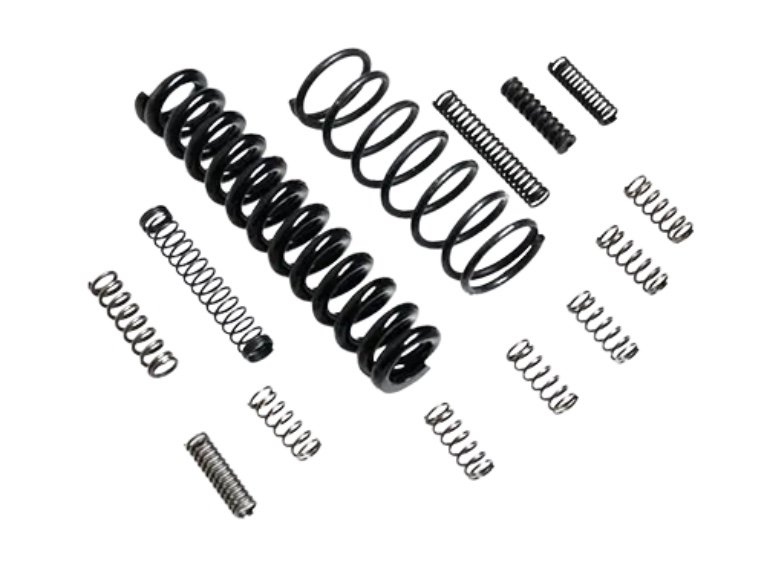
A lotion pump is a small product with a large expectation: every press should feel the same, every dose should be the same, and it should still feel that way on the four-hundredth use. None of that comes from the plastic. It comes from two or three springs inside the head that nobody sees.
When a pump head is tooled, the spring is usually the last thing specified and the first thing to cause trouble. Not because it is hard to make one — a competent winder makes one in minutes. Because a pump head is a volume product, and the quantity changes the problem entirely.
The barrier is consistency, not difficulty
Most fine-wire parts are not geometrically demanding. A return spring for a lotion pump is a few coils of wire under a millimetre in diameter, with flat-ground ends. There is no exotic geometry and no heroic forming operation.
What makes it difficult is that the part is made in millions, assembled on a high-speed line, and dropped into a product a customer will judge by feel. Three drift mechanisms matter:
- Wire tolerance. At 0.10 mm wire, the published tolerance band is a meaningful fraction of the diameter. Two reels at opposite ends of the band produce two springs with measurably different rates — and the assembly line will find both of them.
- Coil count. One extra active coil changes the rate by roughly the same proportion. It is also the single most common unintended change in a long production run.
- End grinding. Uneven grinding changes both the solid height and the squareness of the load path. In a head where the spring sits on a plastic seat, a slightly tilted end loads the seat unevenly and the press feels different.
Three parts, three different jobs
Our pump and dispensing page splits a pump head into three spring functions. They fail for different reasons, which means they have to be specified differently.
The return spring
This is the main actor. It sets the press force and drives the return, and the force window is narrow in both directions: too soft and the press feels vague, too firm and it is hard to actuate. The return also has to be crisp — hesitation on the way up is felt immediately. Wire is typically a fraction of a millimetre and the ends are ground flat so the spring seats squarely. This is the part where coil count and end grinding drift shows up first.
The valve spring
The valve spring controls delivery and prevents backflow. The engineering requirement is a clean seal and no loss of function after long contact with the product. That makes it a materials question before it is a mechanics question: SUS304 or SUS316L is usual, and the choice depends on what is in the bottle. An alcohol-based product, a citrus cleaner and a silicone lotion put very different demands on a stainless surface.
The actuator spring or strip
This sets the travel limit and the feel of the stroke. Depending on the mechanism it can be a compression spring or a stamped strip. When it is a strip, the stamping die and its wear state become the consistency risk rather than the coiling machine — which is a different supplier capability and worth separating in the drawing package.
Media compatibility decides the material
For a spring that touches the product, corrosion resistance and media compatibility come before piece price. That ordering is not a platitude; it is what happens when a customer switches from a neutral lotion to an alcohol-based gel and the same spring suddenly starts showing surface attack.
Two practical rules:
- Default to SUS304, specify SUS316L where chlorides or aggressive actives are present. The step up in molybdenum content is cheap insurance on a part this small.
- Passivate anything that has been machined, ground or tumbled. Those operations embed free iron in the surface. Passivation removes it and restores the chromium oxide layer the corrosion resistance depends on.
Where the spring does not touch the product — an actuator spring behind a seal, for instance — the material can be chosen on mechanics alone, which usually means a higher-carbon wire for better fatigue behaviour at a lower cost.
Testing: what can and cannot be promised
Pump head springs are cycled far beyond what a compression test can simulate in a reasonable time. Cycle testing and salt spray testing follow the customer’s test method, with reports available by lot.
What we do not do is put a fatigue life figure on a drawing. Fatigue life depends on the actual stress cycle, the surface condition, the environment and the assembly, and a number printed on a certificate does not survive contact with a real product. What can be committed to is the process: the wire grade, the shot peening where specified, the stress relief parameters, and the batch records that show the process was followed. If a life figure has to be demonstrated, that is a test programme, quoted separately, not a line on a datasheet.
Mixing valves and pumps in one review
Aerosol valve springs sit close enough to pump springs that they are usually sourced from the same supplier, and our valves and fluid control page covers them from the sealing side. The overlap is real: a valve spring has to hold a seal under media contact, which is the same question a pump valve spring answers.
If a customer has both pump heads and aerosol valves, quoting them together is usually better than quoting them separately. The wire, the finishes and the inspection methods are shared, and one qualified process covers both part families.
What a supplier actually needs
The quotation on a pump head spring moves quickly once the assembly method is clear, because the assembly method is what defines the force window. The useful package is:
- Drawing or a current sample
- Monthly and annual usage
- Assembly method and orientation — how the spring is seated and which end carries the load
- The media the spring contacts, and the cleaning or filling process
- Whether lot certificates or cycle test reports are required
Assembly orientation is the item most often left out and the one that most often changes the answer. The same spring seated the other way round can feel completely different in the hand.
The short version
Pump head springs are simple parts in a difficult production regime. The part is easy; the millionth part is the work. Tighten the wire specification, lock the coil count, control the end grinding, choose stainless for contact with the product, and require lot records rather than a life claim.
Related reading: why springs break · passivation for stainless springs · why the second batch is the real test · springs for pump heads and dispensing
Tooling a new pump head?
Send the drawing, the volume and the assembly method. We will confirm the force window and the material before the first prototype is wound.