
Application Guide
Safety valve springs:
the three numbers behind set pressure.
In a relief valve, the spring is not a component. It is the calibration. Force tolerance, permanent set and stress relaxation are what decide whether the valve still opens at the right pressure after a hundred thousand cycles — and only one of the three is written on most drawings.
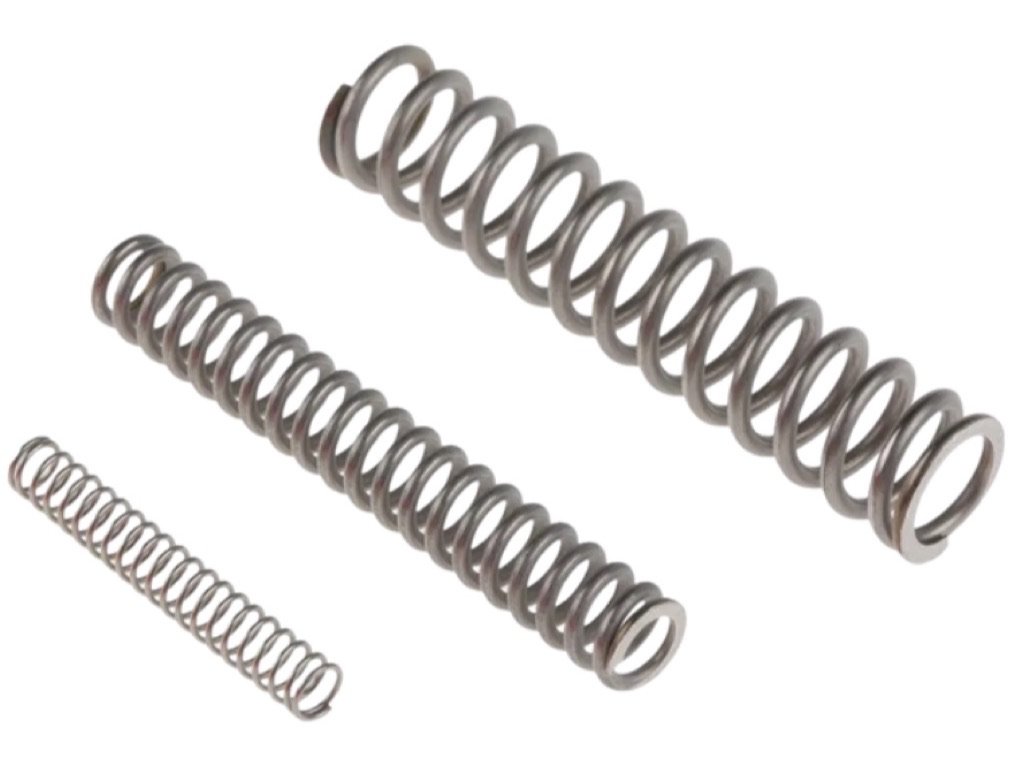
Valve engineers do not ask whether a spring is strong enough. They ask whether the force is still accurate in three years. That is a different question, and it usually gets a worse answer.
A safety valve that opens at 4.0 bar on the bench and at 3.6 bar after two years in service has not failed in the ordinary sense. Nothing broke. The spring simply relaxed, and the set pressure moved with it. The mechanism is covered properly in the fatigue guide, but relaxation and fatigue are not the same failure and they are not controlled the same way.
Why the spring is the calibration
In most valve designs the only thing holding the disc against the seat is the spring. Set pressure is therefore a direct function of spring force at the installed height:
Set pressure = spring force at lift ÷ effective seat area
Every variable on the right side is either fixed by machining or left to the spring. If the spring force drifts by 5%, the set pressure drifts by 5%. On a valve rated at 10 bar, that is half a bar — enough to fail a certification test and, in the wrong service, enough to matter.
The three numbers
Our valves and fluid control page works to three measures. Each one catches a different way a valve goes out of calibration.
1. Force tolerance at installed height
This is the one number almost every drawing already carries, and it is the easiest. It defines the load window at the assembled height, and it is what a load cell on the bench measures.
It is also the least interesting of the three, because a spring that meets its force tolerance on day one can still be out of tolerance on day three hundred.
2. Permanent set
Permanent set is how much length is lost after the spring is compressed — either to solid or to a defined proof load. It is a one-time plastic deformation that shows up immediately after the first over-travel event, and it is why a valve that was set correctly at the factory can be out of adjustment after its first relief cycle.
Two things drive it: the stress level the spring is designed to during proof, and whether the winding and heat treatment left the wire in a stable state. A spring wound from good wire but under-stress-relieved will take a set it should not have taken.
The control is straightforward: specify a proof load or a solid-height compression, and measure the length change afterwards. It is a cheap check and it catches a whole class of process problems.
3. Stress relaxation
Relaxation is the slow one. A spring held compressed at temperature loses force over time even with no cycling at all — the material creeps at the microstructural level. In a relief valve that sits closed for two years and then has to open at the correct pressure, relaxation is the failure mode that matters most.
It is also the one most often left out, because it requires a test that takes time: hold the spring at a defined compression and temperature for a defined period, then measure the residual force. A supplier without that capability cannot quote against it, and a customer who does not ask will not find out until the valve is in service.
The four valve types and what each really needs
Safety and relief valves
All three numbers, written into the drawing. This is the one valve type where the spring is unambiguously the calibration element, and the one where a vague specification is most expensive. Force tolerance, permanent set and relaxation should all appear, with the test method for each.
Ball and butterfly valves
Disc spring stacks provide the sealing preload rather than a single coil. Stack count, stiffness matching and compression travel decide the seal life. A single-disc specification means nothing here — the behaviour of a stack is not the behaviour of its discs, and the load-deflection curve has to be specified for the stack as assembled.
Check valves
Mostly small-wire return springs. The difficulty is not the load; it is medium compatibility and staying free from sticking over a long service life. A check valve spring that corrodes and sticks open fails silently — there is no set pressure event to notice. Material selection carries this part.
Aerosol valves
Tiny parts in large numbers, where seal face fit and batch consistency matter more than load. The overlap with pump head springs is substantial, and customers who buy both are usually better served by one qualified process for both families than by two suppliers with two inspection regimes.
Materials and what can be certified
SUS304 and SUS316L are the default for valve springs, with 316L where chlorides or aggressive media are present. For industrial valves that see steam or high temperature, the material choice moves toward alloys that hold their modulus and their corrosion resistance at temperature — and relaxation behaviour becomes the deciding property rather than the ambient load.
What can be provided with the parts:
- Batch material certificates — traceable to the wire mill and heat number.
- Relaxation test reports — per the agreed method and duration.
- Load and dimensional inspection data — per lot, from the in-house laboratory.
- Salt spray results where a coating or finish is specified.
What is not provided is a blanket life guarantee. A valve spring’s in-service behaviour depends on the medium, the temperature, the cycle profile and the installation, and a number printed on a certificate does not survive that. Where a life figure has to be demonstrated, it is a test programme with its own quotation.
What to put on the drawing
For a relief valve spring, a drawing that will actually hold a set pressure over time looks like this:
- Set pressure, effective seat area and the resulting required force at installed height
- Working stroke and the maximum lift the spring will see
- Media, temperature range and cycle count over the service interval
- Force tolerance at installed height
- Proof load or solid-height compression, and the maximum permitted permanent set
- Relaxation limit at the service temperature and duration
- Material and surface finish, including passivation for stainless
- Whether a batch material certificate and test report are required per shipment
Eight lines. Every one of them is a question a supplier can answer with a measurement, which is the only kind of answer worth putting in a valve file.
The short version
Set pressure is a spring force question, and a spring force that has to hold for years is a relaxation question. Ask for all three numbers — force tolerance, permanent set and stress relaxation — and ask which one the supplier can test rather than quote. The one they cannot test is the one that will move.
Related reading: seat pressure loss in engine valve springs · why springs break · springs for valves and fluid control
Specifying a relief valve spring?
Send the set pressure, the working stroke, the medium and the required cycle count. We will quote against all three measures, with test reports by lot.